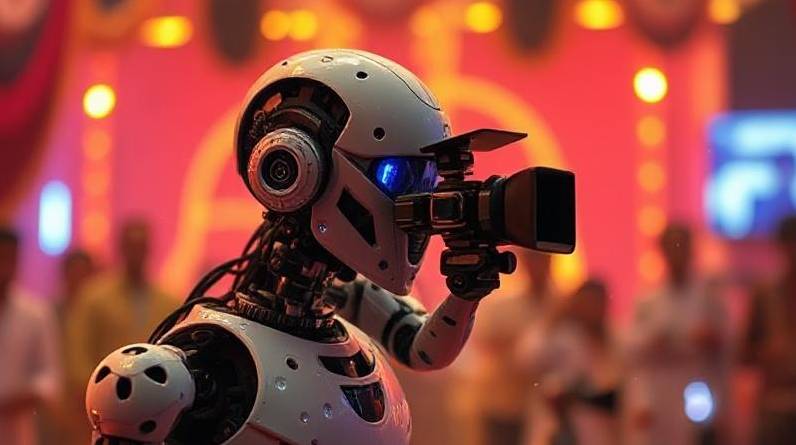
Artificial Intelligence (AI) has become the new disruptor in India’s multibillion-dollar film industry. Once celebrated solely for its human creativity — vibrant storytelling, elaborate dance numbers, and emotional depth — Bollywood now stands at the threshold of an unprecedented transformation. From rewriting scripts to recreating actors, AI is reshaping how stories are conceived, shot, and even experienced by audiences.
But amid the excitement lies an essential question: Can technology enhance Bollywood’s magic without erasing its soul?
The New Age of Filmmaking: When Code Meets Creativity
AI in Bollywood isn’t just a futuristic fantasy anymore — it’s already here. Filmmakers, producers, and advertisers are experimenting with AI to streamline processes, cut costs, and push the boundaries of imagination.
Key Areas Where AI Is Making an Impact
| Area of Film Production | AI Application | Example/Impact |
| Scriptwriting & Story Development | AI chatbots assist in drafting or analyzing scripts. | Shekhar Kapur used ChatGPT to draft a sequel to Masoom (1983). |
| VFX & De-Aging | AI accelerates complex effects and reduces manual editing. | Tamil film Weapon featured India’s first AI-generated sequence. |
| Post-Production Editing | Automated editing tools enhance color grading, sound, and scene continuity. | Redchillies.vfx (founded by Shah Rukh Khan) uses AI-assisted post-production tools. |
| Marketing & Advertising | Deepfake and personalization for mass campaigns. | Cadbury’s “Not Just a Cadbury Ad” with Shah Rukh Khan created 300,000 personalized AI ads. |
| Archival Restoration & Dubbing | AI restores old films and generates multilingual dubs while maintaining lip-sync. | Growing trend in re-releases and OTT localization. |
AI-Generated Films: From Imagination to Reality
The line between human and machine creativity is blurring fast. The 2025 announcement of Chiranjeevi Hanuman – The Eternal marked India’s first fully AI-generated feature film, merging mythology with digital artistry.
This ambitious project promises a cinematic universe built entirely by algorithms — from script to visuals — designed for global audiences. Yet, while it signals innovation, it also raises questions: Where does human creativity fit in when machines can “imagine” too?
Filmmaker Vikramaditya Motwane voiced his apprehension: “Who needs writers and directors when it’s ‘Made in AI’?”
Still, others like Shekhar Kapur view AI differently — as an equalizer rather than a threat. Kapur envisions a future where AI democratizes filmmaking, allowing talented creators from modest backgrounds to produce high-quality films without big studios. “AI will empower creators and level the playing field,” Kapur said.
The Raanjhanaa Controversy: When AI Crosses Ethical Lines
Bollywood got its first taste of AI-fueled controversy in 2025, when an AI-modified version of Raanjhanaa (2013) was released in Tamil with a different ending — turning a tragic death into a hopeful revival.
Director Aanand L. Rai and actor Dhanush condemned the move as a violation of artistic integrity, sparking a nationwide debate on creative consent and film legacy.
“This alternate ending has stripped the film of its very soul,” Dhanush posted on social media.
This incident revealed a deeper concern: AI can not only create new art but alter existing works, challenging notions of authorship, ownership, and authenticity.
How Bollywood Professionals Are Adapting
Despite concerns, several industry veterans are embracing AI — carefully and creatively.
1. Redchillies.vfx: The Tech Pioneers
The visual effects powerhouse behind films like Jawan and Pathaan integrates AI for concept generation, facial tracking, and background enhancement. Though its head, Harry Hingorani, notes that AI-generated imagery still lacks “the richness of 4K cinema,” the efficiency it offers in repetitive tasks is undeniable.
2. Shekhar Kapur: The Visionary Director
Kapur not only used AI for writing but also plans to establish an AI film school in Mumbai’s Dharavi slum to empower aspiring storytellers with digital tools. His goal: make filmmaking accessible to anyone with a story to tell, not just those with resources.
3. Shakun Batra: Merging Emotion with Algorithms
Known for Kapoor & Sons and Gehraiyaan, Batra created a five-part AI-assisted short film series. However, he insists that technology must serve creativity — not replace it. “The best future would be when two skill sets merge,” he said.
Beyond the Screen: AI’s Expanding Role in Film Marketing
AI isn’t limited to production; it’s revolutionizing film promotion and audience engagement.
The Cadbury “Not Just a Cadbury Ad” campaign (2021) stands as one of the most successful AI-driven marketing initiatives in India. By using deepfake technology, it allowed small businesses to create personalized ads with Shah Rukh Khan endorsing their shops — producing more than 300,000 localized commercials.
This campaign demonstrated how AI can combine star power and data analytics to reach audiences in hyper-personalized ways — something Bollywood studios are now adopting for movie marketing and trailers.
Balancing Innovation with Integrity
As AI’s influence grows, the industry faces a balancing act between technological innovation and creative authenticity.
Ethical Challenges Ahead
- Creative Ownership: Who owns an AI-generated script — the machine, the programmer, or the producer?
- Consent and Deepfakes: How do we ensure actors’ likenesses aren’t misused?
- Cultural Sensitivity: Can algorithms understand the nuances of Indian storytelling, religion, and emotion?
- Job Displacement: AI tools might replace entry-level editors, extras, and VFX assistants.
Legal Developments
Actor Anil Kapoor’s legal victory in 2023 established a precedent by granting him rights over his digital likeness, voice, and image. This case underscores the urgent need for clear AI ethics and legal frameworks in Indian entertainment.
Why AI Might Be Bollywood’s Greatest Equalizer
While Hollywood’s AI debates focus on job security and creative control, Bollywood’s conversation has a unique dimension: accessibility.
India produces over 1,500 films annually across various languages. For many small filmmakers, AI could mean the difference between dream and reality.
Potential Benefits
- Cost Reduction: AI can replace expensive crowd simulations and CGI environments.
- Global Reach: Automated dubbing and subtitling break linguistic barriers.
- Faster Production: Editing timelines cut by 30–50% using AI-assisted workflows.
- Inclusivity: Enables creators from small towns or slums to produce world-class content with minimal resources.
Kapur summarized this vision best: “AI is a hugely democratic technology because it gives opportunities to those who would never get it.”
The Road Ahead: Redefining Creativity, Not Replacing It
Bollywood’s future lies in collaboration — not competition — between humans and machines. As directors experiment with AI-driven visuals and writers use algorithms for ideation, the heart of Indian cinema must remain human.
Just as sound didn’t kill silent cinema, or streaming didn’t kill theaters, AI won’t kill creativity. Instead, it will expand the language of storytelling — enabling filmmakers to imagine what was once impossible.
The next few years will likely define the balance between AI’s efficiency and India’s emotional depth — a partnership that could make Bollywood not just technologically advanced, but globally unstoppable.
Key Takeaways
| Aspect | Impact of AI on Bollywood |
| Production Efficiency | Faster, cheaper VFX, de-aging, and scene generation. |
| Creative Collaboration | Writers and directors using AI as a brainstorming partner. |
| Ethical Dilemmas | Ownership, consent, and misuse concerns rising. |
| Democratization | Leveling the field for independent creators. |
| Audience Empowerment | Personalized experiences and redefined storytelling formats. |
Final Thought
AI in Bollywood isn’t just about pixels or algorithms — it’s about possibilities. As filmmakers navigate between innovation and emotion, India’s cinema may emerge as the world’s boldest experiment in fusing art with artificial intelligence. The challenge isn’t whether AI can make movies, but whether it can make them matter.
Frequently Asked Questions (FAQs)
- How is AI currently used in Bollywood filmmaking?
AI is used for scriptwriting, visual effects, de-aging actors, automated editing, dubbing, and personalized marketing campaigns. It helps filmmakers cut costs and speed up production while exploring new storytelling techniques. - What was the Raanjhanaa AI controversy about?
In 2025, an AI-edited Tamil version of Raanjhanaa changed the original tragic ending, sparking outrage from director Aanand L. Rai and actor Dhanush. It raised ethical questions about creative consent and film integrity. - Are there any fully AI-generated Bollywood films?
Yes. Chiranjeevi Hanuman – The Eternal, announced in 2025, is India’s first fully AI-generated feature film that blends mythology and generative AI technology. - How are filmmakers responding to AI adoption?
Reactions are mixed. Some directors, like Shekhar Kapur, see AI as a democratizing tool for aspiring filmmakers. Others, like Vikramaditya Motwane, worry it could erode the human essence of storytelling. - Can AI replace human creativity in films?
Not yet. Experts agree that while AI can assist with technical and repetitive tasks, it lacks emotional depth, moral intuition, and cultural understanding — qualities that define great cinema. - What are the main challenges of AI in Bollywood?
Key concerns include data privacy, misuse of likenesses (deepfakes), lack of legal regulation, and potential job displacement for creative professionals and technicians. - How can AI benefit independent filmmakers in India?
AI can dramatically lower production costs and simplify editing and VFX work, allowing independent creators from smaller towns to produce professional-quality films without huge budgets.